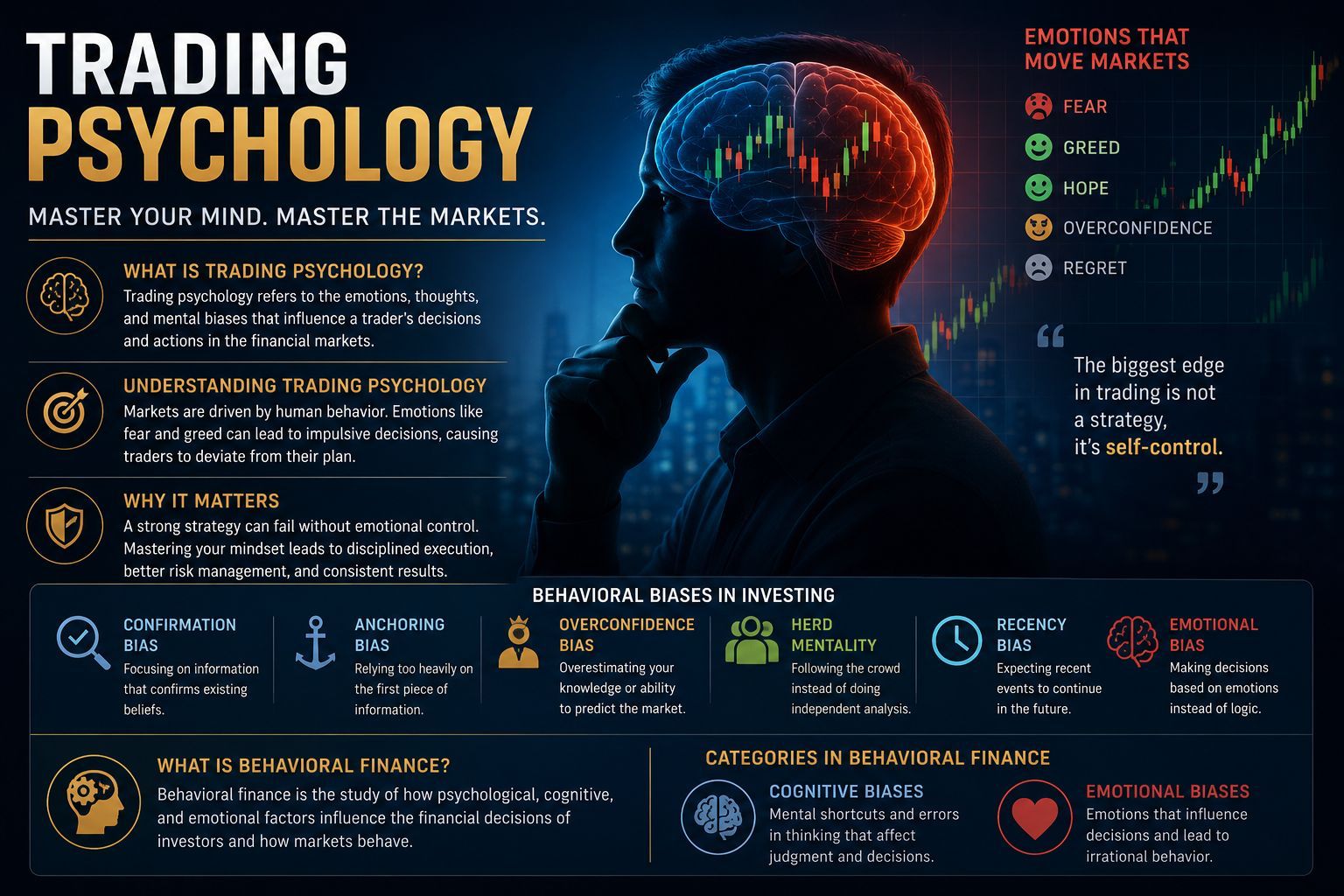
Trading Psychology: Understanding the Mind Behind Market Decisions
In the world of financial markets, success is not determined solely by charts, indicators, or trading systems. More often than not, the real battlefield exists within the mind of the investor or trader. Trading psychology refers to the emotional and behavioral framework that influences how individuals react to market movements, opportunities, risks, profits, and losses. It is the invisible force that quietly shapes decision-making in the market environment.
Many market participants begin their journey believing that profitability depends entirely on technical analysis or market intelligence. However, as experience grows, traders often realize that emotions such as fear, greed, anxiety, overconfidence, impatience, and regret can significantly impact performance. Even the most sophisticated trading strategy can fail when emotional discipline is absent.
Understanding trading psychology is therefore essential because financial markets are not purely mathematical systems, they are ecosystems driven by human behavior. Every buying and selling decision reflects emotions, expectations, assumptions, and reactions to uncertainty. This is precisely why two individuals observing the same chart can make completely different trading decisions.
One of the most common psychological challenges in trading is the fear of missing out (FOMO). Traders often rush into positions simply because they see others profiting from rapidly moving markets. In many cases, this emotional response results in impulsive entries and poorly managed risks. Similarly, greed may encourage excessive leverage and unrealistic expectations, while fear may force traders to exit fundamentally strong positions prematurely.
Another important psychological factor is loss aversion, the tendency of individuals to feel the pain of losses more intensely than the satisfaction of gains. This often causes traders to hold losing positions for too long while exiting profitable trades too early. Such emotional imbalances can gradually weaken long-term portfolio performance.
This is where the concept of behavioral finance becomes highly relevant. Behavioral finance is a field of study that combines psychology and finance to understand how emotional, social, and cognitive biases influence financial decision-making. Unlike traditional finance theories, which assume that investors behave rationally, behavioral finance recognizes that human beings frequently act irrationally under conditions of uncertainty and market pressure.
Behavioral finance broadly studies how investors interpret information, process risk, and react to market events. It explains why markets sometimes move beyond logical valuations and why crowd behavior often creates bubbles, panic selling, or irrational optimism.
Several behavioral biases play a major role in investing and trading decisions:
- Confirmation Bias: Investors tend to seek information that supports their existing beliefs while ignoring contradictory data.
- Anchoring Bias: Traders become emotionally attached to specific price levels or past valuations.
- Overconfidence Bias: Individuals overestimate their knowledge, prediction abilities, or market understanding.
- Herd Mentality: Investors follow the crowd without conducting independent analysis, especially during euphoric market phases.
- Recency Bias: Recent market events disproportionately influence expectations about the future.
- Emotional Bias: Decisions become driven by fear, excitement, anger, or panic rather than structured analysis.
Behavioral finance is generally categorized into two major dimensions. The first is cognitive biases, which arise from flawed reasoning, mental shortcuts, or statistical errors in judgment. The second is emotional biases, which stem from feelings, impulses, and psychological reactions. While cognitive biases can sometimes be corrected through awareness and education, emotional biases are often more difficult to control because they are deeply connected to human instinct.
Professional traders and long-term investors understand that emotional control is one of the greatest competitive advantages in the market. They focus not merely on predicting market direction, but on maintaining consistency, discipline, and risk management regardless of temporary market fluctuations. Successful investing is rarely about reacting emotionally to every movement; it is about following a structured process with patience and clarity.
In modern financial markets, where information travels instantly and volatility can emerge unexpectedly, mastering trading psychology has become just as important as mastering technical or fundamental analysis. Markets reward those who remain rational during uncertainty and disciplined during emotional extremes.
Ultimately, trading psychology teaches one powerful lesson: before mastering the market, an investor must first master the mind.
